
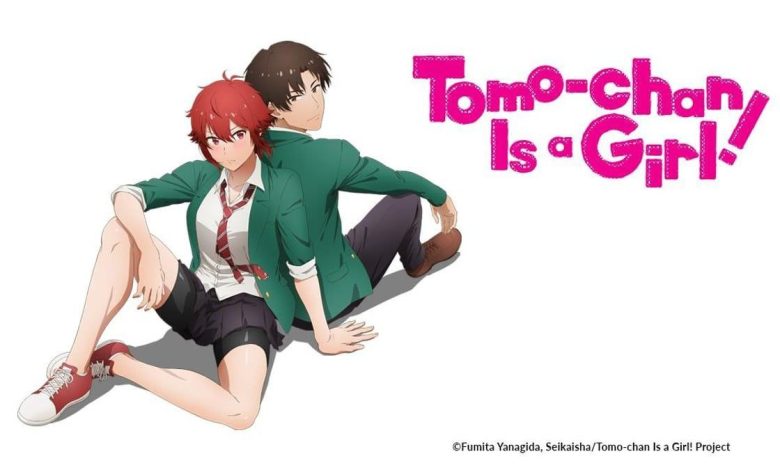
Tomo-chan Is a Girl: The Hilarious, Heartfelt Battle to Be Seen as a Woman
Tomo chan Is a Girl asks a deceptively simple question: What happens when your lifelong best friend—a guy who sees you as his toughest, most reliable bro—is the object of your deepest affection?
For Tomo Aizawa, a girl with the spirit of a championship fighter and a heart of gold, the answer is a daily, hilarious, and often painful struggle. She’s been in love with her stoic, dense childhood friend, Junichirou “Jun” Kubota, for years, but he remains utterly blind to her femininity, viewing her solely as his greatest rival and most trusted comrade.
The series, adapted from Fumita Yanagida’s beloved 4-koma manga, chronicles Tomo’s all-out offensive to make Jun see her not just as “Tomo,” but as “Tomo-chan, a girl.” Tomo-chan Is a Girl is a masterclass in using a single, potent comedic hook to explore themes of identity, friendship, gender performance, and the awkward, beautiful chaos of first love.
Information 

Tomo-chan Is a Girl!
➻ Type :- TV
➻ Genres :- #Romance, #Comedy, #School, #SliceOfLife
➻ Status :- Finished Airing (Season 1)
➻ Aired :- 2023
➻ Language :- Tamil Dub
➻ Episode :- 13
➻ Duration :- 24 min per ep
This guide will be your training manual for this feel-good hit. We’ll analyze the unbeatable chemistry of Tomo and Jun, dissect the brilliant supporting cast, explore the series’ clever subversion of shonen and shojo tropes, and reveal why this compact, 13-episode gem became one of the most celebrated rom-coms of its year.
Table of Contents
Prologue: A Declaration of War on Density – The Premise
The engine of Tomo-chan Is a Girl is its perfectly calibrated central conflict, established with efficient charm. Tomo Aizawa is not your typical anime heroine. She’s loud, boisterous, supremely athletic, and possesses a competitive streak a mile wide. She and Jun have been inseparable since childhood, bonding over who could climb a tree faster or win a fight. To Jun, Tomo is his equal, his benchmark for strength—a concept he has entirely divorced from gender.
On the first day of high school, Tomo finally musters the courage to confess her love. Jun’s response? He thinks she’s challenging him to a fight. This catastrophic misunderstanding is the inciting incident that launches Tomo’s “campaign.” Her goal is clear: make Jun recognize her as a romantic prospect. Her tactics, however, are hilariously flawed, often relying on the very brute-force, straightforward approach that cemented her “bro” status in the first place. The series finds endless comedy and heart in the gap between Tomo’s fierce, genuine feelings and Jun’s impregnable, respectful blindness.
Chapter 1: The Unlikely Heroine – Tomo Aizawa, A Girl of Contradictions
Tomo is a landmark protagonist because she forcefully rejects passive feminine archetypes while desperately wanting to be seen as feminine.
- Strength as Identity, Strength as Barrier: Tomo’s physical and competitive prowess is her core trait. She’s introduced beating up a gang of delinquents. This strength is authentic and celebrated, a part of her she never wants to lose. Yet, it’s the very trait that built the “bro” wall between her and Jun. Her journey isn’t about becoming weaker or more “girly”; it’s about expanding Jun’s (and her own) definition of what a girl can be.
- The Heart of a Brawler, the Sensitivity of a Teen: Beneath her tough exterior, Tomo is emotionally vulnerable, easily flustered by Jun, and deeply insecure about her lack of traditional femininity. Her attempts to act “cute” or “ladylike” are awkward and endearing because they feel like a performance, a second language she’s trying to learn. The series’ genius is showing that her genuine, unfiltered self—loud, passionate, direct—is her most attractive quality; it just needs to be reframed in Jun’s mind.
- The Active Pursuer: Tomo shatters the trope of the passive love interest waiting to be noticed. She is the driver of the romance. She initiates conversations, engineers “dates,” and directly confronts Jun about his feelings (even if he doesn’t get it). Her agency is the story’s lifeblood.
Chapter 2: The Immovable Object – Junichirou Kubota, Master of Misinterpretation
Jun is not a cruel or intentionally dismissive love interest. His density is a specific, character-driven flaw rooted in profound respect.
- The “Tomo” Category: In Jun’s mind, “Tomo” exists in a category of one, separate from “girls.” He holds her in the highest esteem—as his ultimate rival and most dependable friend. His failure to see her romantically stems from this rigid categorization. To him, thinking of Tomo “that way” would feel disrespectful to their pure, competitive bond.
- Stoic, Not Heartless: Jun is quiet, observant, and fiercely protective. His care for Tomo is evident in every action—walking her home, silently supporting her, instantly recognizing when she’s upset. He simply doesn’t label these actions as “romantic.” His eventual awakening isn’t about Tomo changing, but about him realizing his deep-seated feelings have always been romantic; he just didn’t have the framework to understand them.
- The Humor of Literal-Mindedness: Jun’s deadpan, literal reactions to Tomo’s advances are the source of the series’ best gags. A romantic gesture is interpreted as a new training regimen. A cute outfit is assessed for its combat practicality. This creates a perfect comedy loop: Tomo tries, Jun misinterprets, Tomo gets frustrated, and the audience delights in the disconnect.
Chapter 3: The Strategic Support Staff – Misuzu and Carol
The series elevates itself from a two-person act to an ensemble masterpiece with Tomo’s two best friends, who provide strategy, contrast, and their own brilliant subplot.
- Misuzu Gundo: The Scheming Puppet Master
The quintessential “ice queen” with a hidden, mischievous heart. Misuzu is Tomo’s childhood friend, a genius-level strategist who finds the Tomo/Jun dynamic to be the world’s most entertaining soap opera. She devises elaborate, often manipulative plans to push Jun’s buttons and force realizations, all while maintaining a facade of bored detachment. Her own complex, tsundere-like relationship with the gentle giant Kosuke provides a parallel romance that explores different facets of love and communication. - Carol Olston: The Chaotic Sunshine
The wealthy, half-Japanese transfer student who becomes the group’s radiant core. Carol is pure, unfiltered id—energetic, emotionally intelligent, and bizarrely powerful. She embraces Tomo immediately and supports her with relentless, if sometimes confusing, positivity. Carol acts as the emotional translator for the group, often voicing the obvious truths everyone else misses. Her dynamic with the timid Tatsumi is a hilarious and sweet exploration of opposites attracting.
Together, Misuzu and Carol form Tomo’s essential support system. They are her cheerleaders, therapists, and tactical advisors, representing the irreplaceable value of female friendship in a story about romantic love.
Chapter 4: The Comedy of Errors – Deconstructing Romantic Tropes
Tomo-chan Is a Girl derives its humor from a meticulous deconstruction of standard rom-com scenarios.
- The Failed Confession: The classic trope is stretched to its breaking point and becomes the series’ foundation.
- The “Practice Date”: Tomo’s attempts to go on a date with Jun are constantly hijacked by their instinct to turn everything into a competition, from eating to window-shopping.
- The Rival’s Entrance: When a traditional, feminine love rival appears, she fails spectacularly because she doesn’t understand that Jun’s “type” isn’t a generic idea of a girl, but the very specific person of Tomo.
- The Beach/Hot Springs Episode: These fan-service staples are subverted. The focus isn’t on leering, but on Tomo’s acute self-consciousness about her non-“feminine” body and Jun’s complete lack of a lascivious reaction, which frustrates her in a new way.
The humor is never mean-spirited. It springs from character and the painful, relatable gap between intention and perception.
Chapter 5: Themes – More Than Just a Punchline
Beneath the gags lies a surprisingly nuanced exploration of identity and perception.
- Gender Performance and Authenticity: Tomo’s struggle is a microcosm of societal pressure to fit into gendered boxes. The series argues that femininity is not a monolith. Tomo’s strength, loudness, and directness are just as valid expressions of being a girl as Misuzu’s elegance or Carol’s cuteness.
- The Depth of Friendship: The Jun-Tomo relationship is first and foremost a deep, unwavering friendship. The romance grows from that solid bedrock. The series celebrates platonic love as the essential foundation for lasting romantic love.
- Communication and Emotional Literacy: The core conflict is a massive communication breakdown. Jun’s emotional stoicism and Tomo’s inability to express her vulnerability directly are the twin obstacles. Their growth is learning to communicate in a shared emotional language.
- Self-Worth and External Validation: A significant part of Tomo’s arc is learning that her value isn’t contingent on Jun’s recognition. She must embrace herself fully before she can healthily seek his affection.
Chapter 6: The Adaptation – From 4-Koma to Fluid Animation
The anime adaptation, produced by Lay-duce, was hailed as a near-perfect translation of the source material.
- Pacing and Structure: The 13-episode season adeptly condensed the manga’s 4-koma strips into a fluid narrative, maintaining the gag-a-minute pace while allowing emotional moments to breathe. The choice to adapt the complete story gave viewers a supremely satisfying, closed-loop experience.
- Voice Acting Excellence: The casting was iconic. Rie Takahashi brings Tomo to life with a stunning range, shifting from raucous battle cries to tender, flustered whispers. Kaito Ishikawa’s deadpan delivery as Jun is perfect, making his rare emotional slips incredibly powerful. Sally Amaki as Carol and Rina Hidaka as Misuzu round out a flawless main cast.
- Visual Storytelling: The animation uses chibi expressions and dynamic reaction shots masterfully to enhance the comedy. The character designs faithfully capture the manga’s charm, with Tomo’s iconic ahoge (cowlick) and Jun’s perpetually calm eyes being central to their visual communication.
Chapter 7: Cultural Impact & Enduring Appeal
Tomo-chan Is a Girl resonated because it delivered a specific, heartfelt fantasy with universal appeal.
- The “Girl Who’s One of the Guys” Fantasy: It gave voice to a common experience for many women, validating the feeling of being seen as a “bro” while nurturing romantic feelings within that dynamic.
- A Satisfying, Conclusive Narrative: In an era of open-ended seasons, it told a full, satisfying story with a definitive and heartwarming conclusion, leaving fans elated rather than hungry for more.
- A Celebration of Earnestness: In a cynical age, the series’ unabashed sincerity was its superpower. It’s a rom-com devoid of malice or melodrama, fueled by genuine affection between all its characters.
Conclusion: The Victory of Being Seen
Tomo-chan Is a Girl triumphs because it understands that the most compelling romantic battle isn’t against a rival, but against perception itself. It’s the story of a girl fighting to be seen in her entirety—strength and softness, friendship and love, rival and soulmate—by the person whose opinion matters most.
Through relentless comedy and genuine heart, it delivers a timeless message: love isn’t about changing who you are to fit someone’s ideal. It’s about finding someone who loves you for the authentic, contradictory, wonderful person you already are. Tomo’s victory isn’t in making Jun see a girl; it’s in making him see Tomo, and in doing so, realizing she was always the one. For its flawless execution, unforgettable characters, and powerfully earnest spirit, Tomo-chan Is a Girl cemented itself as a modern rom-com classic, a hilarious and heartfelt reminder that sometimes, the person you’re meant for is the one standing right next to you, if you can just get them to look at you the right way.

Also Check
- True Beauty (Season 01) Tamil [480p 720p 1080p]
- The Great Cleric (Season 01) Tamil [480p 720p 1080p]
Final Summary 🪶
IMDB - 7.5
MyAnimeList - 9.2
8.4
Average Score
Tomo-chan Is a Girl is a really fun rom-com. The tomboy energy and constant misunderstandings make it hilarious. The characters bounce off each other perfectly. It’s light, funny, and super easy to enjoy.


One Comment