
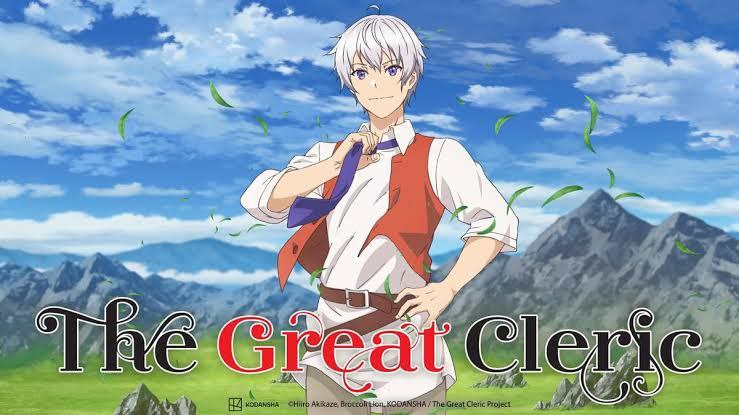
The Great Cleric: The Slow, Painful, and Brilliant Grind of a Healer in a World of Brutes
The Great Cleric (Seija Musō), adapted from the light novel by Broccoli Lion, presents a fantasy world not as a playground, but as a grueling, bureaucratic, and brutally meritocratic system.
It follows the reincarnation of a dedicated Japanese salaryman, Luciel, who is reborn into a world of magic, monsters, and a fearsomely efficient institution known as the Healer’s Guild—or more accurately, the Mercenary Guild’s Church Branch.
With no cheat skills, no special lineage, and only his past life’s work ethic and trauma-driven fear of death, Luciel embarks on a journey to become the titular Great Cleric. This is not a story of instant heroism, but a meticulous, almost documentary-like chronicle of training, paperwork, institutional politics, and the profound respect earned through relentless, self-sacrificial effort.
Information 

The Great Cleric
➻ Type :- TV
➻ Genres :- #Isekai, #Fantasy, #Adventure, #Comedy, #Healing
➻ Status :- Finished Airing (Season 1)
➻ Aired :- 2023
➻ Language :- Tamil Dub
➻ Episode :- 12
➻ Duration :- 24 min per ep
This compendium will be your guide through Luciel’s arduous ascent. We will dissect the unique mechanics of the Mercenary Guild, analyze Luciel’s salaryman psychology, explore the series’ deconstruction of healer tropes, and uncover why The Great Cleric has carved out a devoted niche as the “isekai for adults who understand the grind.”
Table of Contents
Prologue: From Salaryman to Novice – A Second Life Forged in Trauma
The foundation of The Great Cleric is its relatable and poignant premise. In his first life, our protagonist was a nameless, overworked salaryman who met a sudden, meaningless death. In his final moments, a divine voice offers him reincarnation into a fantasy world with one boon: he can keep the memories and personality of his past life.
He is reborn as Luciel, an orphan in a backwater church. His driving motivation is not adventure or glory, but a deep, existential terror born of his untimely death: he never wants to die again.
This fear manifests not as cowardice, but as an obsessive-compulsive drive for preparedness and survivability. Seeing healing magic as the ultimate tool for survival, he sets his sights on the legendary Church of the Mercenary Guild in the royal capital—renowned as the toughest, most demanding, and most effective training ground for healers on the continent.
Luciel doesn’t seek to become a hero; he seeks to become unbreakable. This pragmatic, survivalist goal, rooted in adult trauma rather than teenage fantasy, immediately sets the series apart.
Chapter 1: The Unlikely Protagonist – Luciel, the Salaryman Saint
Luciel is a revolutionary isekai protagonist because his “cheat” is entirely psychological and experiential.
- The Salaryman Mentality: Luciel’s greatest asset is the mindset of a diligent corporate employee. He understands hierarchies, the importance of paperwork, the value of building professional networks, and, above all, the power of consistent, incremental effort. He approaches magic training like a demanding new job, creating schedules, seeking feedback from superiors (the Guild’s instructors), and constantly looking for ways to optimize his workflow.
- Trauma as Fuel: His fear of death is his engine. It pushes him to train past the point of exhaustion, to seek out dangerous situations to test his limits, and to stockpile resources and allies. This isn’t reckless bravery; it’s calculated risk management by someone who has seen the final balance sheet.
- The Healer’s Paradox: Luciel embodies the series’ core thesis: a truly great healer must first become a great warrior. To survive on a battlefield and get to his patients, he must be physically robust, martially skilled, and strategically minded. His training is thus a holistic regimen of magic, swordsmanship, endurance, and alchemy. He redefines the cleric from a fragile backline supporter into a resilient, frontline combat medic.
Chapter 2: The Crucible – The Mercenary Guild’s Church Branch
The setting is not a traditional adventurer’s guild or a peaceful temple. The Mercenary Guild is a hyper-competitive, state-sanctioned corporation, and its Church Branch is the most notorious department within it.
- Efficiency Over Ethics: The Guild operates on cold, brutal logic. Healers are not holy figures; they are high-value assets. Their training is designed to maximize survivability and utility. It’s less seminary, more special forces boot camp. Failure means expulsion or death.
- The Instructors – Monsters of Competence: The staff are legends who have survived the worst battlefields. Figures like Brod, the weaponmaster, and Galba, the head instructor, are not kind mentors. They are ruthless drill sergeants who test Luciel through extreme physical and magical duress, believing that true strength is forged in the crucible of near-death experiences. Their approval, hard-earned, is worth more than any treasure.
- The Grind is the Narrative: A significant portion of the story is dedicated to the minutiae of Luciel’s training: his daily routine, his mana control exercises, his alchemy practice, his endurance runs. This focus on process makes his eventual power spikes feel profoundly earned. The Guild itself is a character—an impersonal, demanding system that Luciel learns to navigate and ultimately master.
Chapter 3: The Magic System – Healing as a Discipline
Magic in The Great Cleric is treated as a technical skill, akin to surgery or engineering, rather than a mystical gift.
- Mana and Stamina as Resources: Luciel’s limits are clearly defined. He has a large but finite mana pool linked directly to his stamina. Exhausting one exhausts the other. Management of these resources is a constant strategic concern.
- The Science of Healing: The series delves into the “how.” Healing isn’t a generic green glow. It involves diagnosing magical “circuits,” understanding anatomy, prioritizing wounds, and dealing with magical toxins or curses. Luciel’s innovation often comes from applying his world’s basic healing principles with his Earthly logic and work ethic.
- Alchemy as a Core Skill: Unlike many fantasies where potions are bought, Luciel is forced to learn alchemy from scratch. This reinforces the theme of self-sufficiency and adds a crafting/survival element to his repertoire. His potions become another tool for survival and a source of income and political leverage.
Chapter 4: The Supporting Cast – Allies Forged in Adversity
Luciel’s journey is populated by individuals who respect his grind, not his destiny.
- Brod & The Instructors: The primary catalysts for his growth. Their respect is transactional at first—they value his unbelievable work ethic—but evolves into genuine mentorship and paternal pride.
- Monica: A skilled female warrior and healer who becomes Luciel’s first true peer and a template for the balanced fighter-healer he aspires to be. Their relationship is one of mutual professional respect.
- Lumina & The Church Hierarchy: As Luciel rises, he attracts the attention of the broader Church and royal political structure. These interactions shift the narrative from pure training to institutional politics, as Luciel’s abilities make him a valuable (and vulnerable) pawn in larger games.
- The Antagonists – Complacency and Corruption: The primary enemies are not dark lords, but systemic evils: corrupt nobles, lazy or entitled guild members, and bureaucratic inertia. Luciel often fights against systems that devalue hard work or seek to exploit his abilities for petty gain.
Chapter 5: Themes – The Adult Isekai’s Philosophy
The Great Cleric resonates because it applies an adult worldview to a fantasy premise.
- The Dignity of Labor: This is the series’ core theme. Power, respect, and security are not granted; they are earned through sweat, perseverance, and competence. Luciel’s ascent is a celebration of the skilled professional.
- Trauma and Productivity: It explores a complex relationship between past trauma and present drive. Luciel’s fear is unhealthy, but channeling it into disciplined self-improvement becomes his strength. The series asks if such motivation is sustainable or if he must eventually find a healthier purpose.
- Institutional Navigation: It’s a story about understanding and mastering a complex organization. Luciel’s success comes from learning the Guild’s formal and informal rules, building alliances, and proving his worth within its framework.
- The True Meaning of Healing: Beyond spells, true healing is shown as providing stability, safety, and hope. Luciel heals not just bodies, but organizations and communities by being a reliable, competent pillar.
Chapter 6: The Anime Adaptation – Style and Substance
The 2023 anime adaptation, produced by Yokohama Animation Laboratory and Cloud Hearts, faithfully captures the spirit of the grind.
- Pacing the Grind: The anime does not shy away from spending entire episodes on training sequences. It understands that the process is the point, using montages and focused scenes to make Luciel’s incremental progress palpable.
- Visualizing the System: The Guild’s austere, functional architecture and the detailed depiction of magical circuits and alchemical processes reinforce the world’s systematic nature.
- Voice Acting: Yūsuke Kobayashi perfectly captures Luciel’s blend of earnest determination, underlying anxiety, and moments of exhausted deadpan. The veteran cast for the instructors (like Kenjirō Tsuda as Brod) brings gravitas and intimidating presence.
Chapter 7: Why It Stands Out in the Isekai Crowd
The Great Cleric offers a distinct flavor for a specific audience.
- The Anti-Cheat Isekai: It is a direct rebuttal to overpowered protagonist stories. Every advantage is labored for. The satisfaction is vicarious, rooted in the appreciation of hard work paying off.
- Appeal to Working Adults: For viewers familiar with office politics, skill development, and career climbing, Luciel’s journey is deeply relatable and cathartic. It’s a power fantasy of becoming indispensable through sheer competency.
- A Unique Protagonist Archetype: Luciel is neither a naive teenager nor a cynical edgelord. He is a pragmatic, conscientious adult trying to build a secure life in chaotic circumstances—a refreshing change.
Conclusion: The Triumph of the Competent
The Great Cleric is a testament to the idea that the most compelling power fantasy isn’t about limitless strength, but about earned mastery. It is a slow-burn, thoughtful, and deeply satisfying series that finds drama in spreadsheets, tension in training regimens, and heroism in simply showing up and doing the work better than anyone else.
Through Luciel’s journey from a terrified orphan to a pillar of the Guild, it delivers a powerful message: in any world, the true “cheat code” is an unwavering work ethic, a strategic mind, and the courage to face your fears by systematically building the skills to overcome them.
For viewers tired of effortless victories, The Great Cleric offers a richer, more grounded, and ultimately more rewarding ascent. It proves that the path to becoming a legend isn’t paved with divine blessings, but with calloused hands, a drained mana pool, and the unwavering resolve to heal—and strengthen—oneself first.

Also Check
- Tomo chan Is a Girl (Season 01) Tamil [480p 720p 1080p]
- The Gorilla God’s Go-To Girl (Season 01) Tamil [480p 720p 1080p]
Final Summary 🪶
IMDB - 6.9
MyAnimeList - 9.2
8.1
Average Score
The Great Cleric is a solid fantasy anime with a calm pace. The MC’s healing and cleverness make his journey satisfying to watch. It mixes light action with wholesome moments really well. If you like slow-burn adventures with a smart lead, this one’s worth checking out.

