
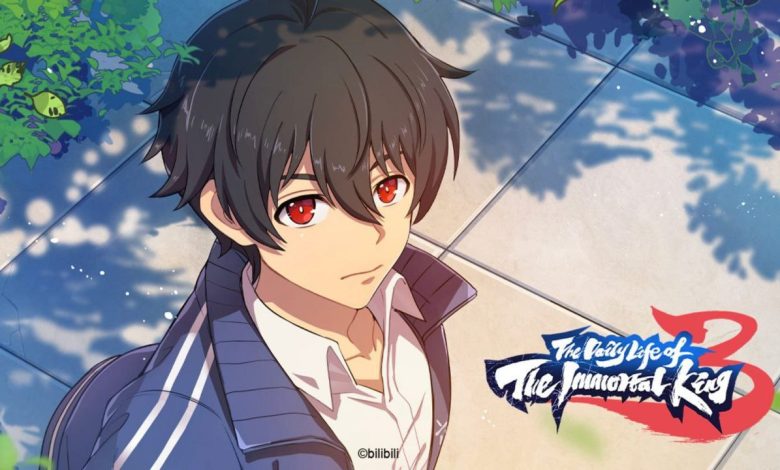
The Daily Life of the Immortal King: When Invincibility is Your Greatest Weakness
In the vast realm of cultivation and xianxia stories, where protagonists spend centuries grinding for a sliver of power, one anime gleefully flips the script on its head. The Daily Life of the Immortal King asks a brilliantly simple question: What if you were born already at the peak?
What if, as a toddler, you could shatter galaxies with a tantrum, and your only wish was to pass high school math? This Chinese anime (donghua) sensation, adapted from Kuxuan’s web novel, follows Wang Ling, a cultivation prodigy of such monstrous, reality-defying power that he had to seal 90% of his abilities at age six just to prevent the world from accidentally ending.
Information 

The Daily Life of the Immortal King
➻ Type :- TV
➻ Genres :- #Action, #Comedy, #Fantasy, #School, #Cultivation
➻ Status :- Finished Airing (Season 1, 2, 3, 4, 5)
➻ Aired :- 2020-2024
➻ Language :- Tamil Dub
➻ Episode :- 15 + 12 + 12 + 12 + 12
➻ Duration :- 24 min per ep
Now a seemingly aloof teenager, his sole, impossible desire is to live an ordinary, quiet life. Of course, the universe—in the form of eccentric cultivators, interdimensional pests, class presidents with hidden agendas, and school competitions—has other plans.
Table of Contents
The Daily Life of the Immortal King is a masterful blend of deadpan comedy, explosive supernatural action, and heartfelt satire of the very genre it inhabits. This compendium will be your manual to this chaotic, overpowered world.
We will analyze the existential comedy of Wang Ling’s plight, dissect the colorful cast that orbits him, explore the show’s unique take on modern cultivation, and uncover why this series has become a beloved cornerstone of donghua.
Prologue: A God in a School Uniform – The Foundation of a Comedy
The premise of The Daily Life of the Immortal King is its core joke, and it’s established with perfect deadpan delivery. Wang Ling is not your typical underdog. From infancy, his spiritual power was so immense it caused celestial phenomena and attracted the attention of the entire cultivation world.
By age six, after casually defeating ancient demon kings and mastering all known (and unknown) arts, he and his family made a pact: he would seal away the overwhelming majority of his power to live a “normal” life and attend a regular cultivation high school, Songshan High.
This creates the series’ perpetual tension. Wang Ling’s “daily life” is a fragile performance. Every moment is a balancing act where using even 0.0001% of his true strength could have cataclysmic consequences. A stray sneeze could alter planetary orbits. A slightly annoyed glance could unravel the fabric of spacetime.
The comedy stems from the extreme dissonance between his god-like reality and his desired banality. He isn’t fighting to become the strongest; he’s fighting against his own strength to preserve a slice of normalcy he never got to experience. This ingenious inversion makes every conflict—from a school sports day to an alien invasion—a high-wire act of controlled, minimal intervention.
Chapter 1: The Unshakable Pillar – Wang Ling, The Reluctant Deity
Wang Ling is a protagonist defined by restraint, making his rare moments of action all the more impactful.
- The Facade of Detachment: To the world, Wang Ling is a cool, silent, somewhat lazy top student. He speaks in monotone, shows little emotion, and seems perpetually bored. This is his carefully maintained camouflage. Beneath the surface, he is a keen observer, deeply caring about his friends and family, and constantly running complex internal calculations to suppress his power and manage the chaos around him.
- The Psychology of Ultimate Power: The series offers a surprisingly nuanced look at the loneliness and burden of invincibility. Wang Ling never had a childhood. He never faced a challenge. His power isolates him, making genuine connection difficult because no one can truly comprehend what he is. His quest for a normal life is, at its heart, a quest for human connection and experience.
- Action as Comedy: When Wang Ling is forced to act, it’s never a struggle. It’s an exercise in precision. The humor lies in the absurd understatement. A universe-ending threat is dispatched with a flick of his finger, often off-screen, while he’s more concerned about his ice cream melting or his anime airing. The anticlimax is the punchline.
Chapter 2: The Supporting Cast – The Chaos That Orbits a Black Hole
Wang Ling’s desired peace is perpetually disrupted by a vibrant, bizarre, and powerful cast of characters.
- Sun Rong (The Unwitting Love Interest & Chief Disturber): The beautiful, powerful, and somewhat tyrannical class president. She is obsessed with “fixing” Wang Ling’s aloof attitude and beating him in competitions, completely unaware she’s trying to out-compete a living god. Her relentless attempts to drag him into school life are the primary engine of slice-of-life chaos.
- Chen Chao & Guo Hao (The Comedic Duo): Wang Ling’s loyal, if clueless, friends. They provide classic comic relief, often getting into trouble that inadvertently requires Wang Ling’s subtle intervention. They see him as a cool, strong friend, but their perception barely scratches the surface of his true nature.
- The Cultivation World at Large: The series populates its world with hilarious takes on xianxia tropes. There are boastful young masters Wang Ling humiliates without trying, ancient elders who tremble in his presence, powerful spirit beasts that act like terrified pets around him, and bureaucratic cultivation unions completely baffled by his existence. They represent the “normal” cultivation world, which serves as a foil to Wang Ling’s absurd power level.
- Wang Ling’s Family: A highlight. His parents and younger “sister” (a powerful spirit beast in the form of a little girl, Little Ling) are fully aware of his power. Their dynamic is hilariously domestic about it. His father brags about him to other dads, his mother scolds him for using too much power while doing chores, and Little Ling is his equally overpowered, but more mischievous, counterpart.
Chapter 3: Genre Satire & World-Building – Modern Cultivation with a Twist
The Daily Life of the Immortal King brilliantly satirizes xianxia conventions while building its own cohesive, modern magical world.
- Cultivation in the 21st Century: Cultivators use smartphones (with special spiritual apps), attend high school, follow modern fashion, and deal with school council politics. Spirit stones are a currency, but so is regular money. This blending of the mystical and the mundane is a constant source of humor.
- The “Power Level” System as a Joke: The series features detailed power level rankings, spirit roots, and cultivation stages—standard genre fare. The joke is that Wang Ling’s metrics are all “???” or break the measuring equipment. He exists outside the system, rendering its drama meaningless.
- Subverting Trope Expectations: Arrogant young masters challenge him, expecting a epic duel; they are ignored or accidentally defeated by a passing bird he empowered years ago. Hidden realms and ancient inheritances are trivialities to him. The series takes the power-fantasy elements of xianxia and pushes them to such a logical extreme that they become comedy.
Chapter 4: Narrative Structure & Comedy Styles
The show’s charm lies in how it balances different modes of storytelling.
- The Slice-of-Life/Comedy Core: Most episodes revolve around school events: exams, sports festivals, class trips, cooking competitions. The joy is watching Wang Ling navigate these mundane trials while supernatural events conspire to ruin his low-key plans.
- The Action Spectacle: When major threats emerge—often interdimensional beings, ancient evils, or rival schools—the animation shifts gears. The fight scenes are dynamic, creative, and beautifully animated, showcasing the power of Wang Ling’s allies and, occasionally, a minuscule fraction of his own might.
- The Running Gag Ecosystem: The series thrives on recurring jokes: Wang Ling’s eternal desire for peace, Sun Rong’s futile attempts to best him, his friends’ misinterpretations of events, and the cultivation world’s collective terror/fascination with the “legendary Wang Ling” who walks among them anonymously.
Chapter 5: The Donghua Production – A Visual and Aural Treat
As a leading donghua, the production values are exceptionally high.
- Animation Quality: Produced by Haoliners Animation League, the series boasts fluid action animation, expressive character designs that balance cuteness and coolness, and creative visual effects for spiritual techniques. The contrast between the bright, modern school life and the epic, cosmic-scale battles is handled seamlessly.
- Voice Acting (Chinese): The voice cast is perfect. Wang Ling’s flat, deadpan delivery (by Zhang Jie) is iconic, contrasting wonderfully with the energetic, often shrill performances of Sun Rong (Qiao Shiyu) and the comedic panic of his friends.
- Music and Sound: The soundtrack features catchy, modern OP/ED songs that fit the show’s energetic tone, alongside more traditional-sounding orchestral pieces for the cultivation and action scenes.
Chapter 6: Themes – More Than Just Gags
Beneath the overpowered comedy, the series touches on resonant themes.
- The Desire for Normalcy: At its core, it’s a story about appreciating the simple, ordinary moments of life—friendship, school, family dinners—that are often taken for granted. Wang Ling’s power has denied him these, making him their most ardent seeker.
- The Burden of Expectations: Wang Ling carries the weight of being the “Immortal King,” a title and destiny he never asked for. The series explores the pressure of living up to (or in his case, down from) immense expectations.
- True Strength and Connection: Ironically, Wang Ling’s journey to become “ordinary” helps him forge the genuine human connections his power prevented. His strength isn’t measured in battles won, but in the fragile, normal life he manages to protect.
Chapter 7: Cultural Impact & Why It Stands Out
The Daily Life of the Immortal King has become a flagship title for donghua internationally.
- A Gateway to Chinese Animation: For many global anime fans, it served as an accessible and high-quality introduction to the world of Chinese animation, demonstrating that donghua can rival Japanese anime in production, storytelling, and humor.
- The Ultimate Power Fantasy… Reversed: It satisfies the power fantasy itch—seeing a protagonist effortlessly crush all opposition—but layers it with comedy and heart, avoiding the pitfalls of an unrelatable, emotionless main character.
- Relatable Despite the Power: Wang Ling’s desire to be left alone, to enjoy simple pleasures, and to avoid unnecessary drama is profoundly relatable, even if his reasons are cosmically scaled.
Conclusion: The Supreme Comedy of Cosmic Proportions
The Daily Life of the Immortal King is a triumph of comedic concept and execution. It takes the well-worn path of the overpowered protagonist and plants a flag at its most absurd, logical conclusion, then builds a heartfelt and hilarious story around it. It is a love letter to and a parody of the xianxia genre, a slice-of-life comedy set on the edge of apocalypse, and a story about a god who just wants to finish his homework.
Through Wang Ling’s endless struggle for a quiet afternoon, the series delivers non-stop laughs, stunning action, and a surprising amount of warmth. It proves that sometimes, the greatest challenge isn’t defeating a demon king, but making it to class on time when you’re the one who could accidentally create a demon king by spilling your breakfast. For its unique premise, flawless comedic timing, and impressive production, The Daily Life of the Immortal King reigns supreme as a cult classic and a must-watch for anyone who loves comedy, action, and stories about the mundane chaos of being literally too powerful for this world.

Season 05
Also Check
Final Summary 🪶
IMDB - 7.1
MyAnimeList - 9.2
8.2
Average Score
The Daily Life of the Immortal King is pure chaos in a fun way. The MC is absurdly overpowered, but the comedy keeps it fresh. It mixes slice-of-life with sudden insane fights. If you want something funny and effortless to watch, this one’s perfect.


One Comment