
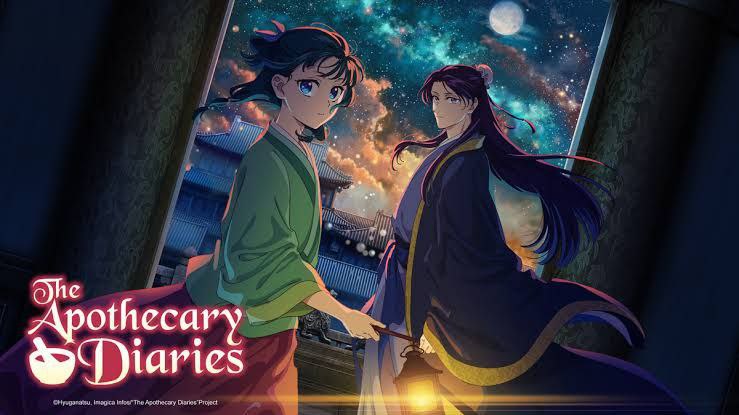
The Apothecary Diaries: How a Court Pharmacist Became the Smartest Person in a Palace of Secrets
The Apothecary Diaries (Kusuriya no Hitorigoto), based on the light novel series by Natsu Hyūga, transports viewers to a fictionalized version of ancient China, within the gilded cage of the Imperial Palace’s Inner Court. Here, hundreds of consorts and their attendants vie for the Emperor’s favor in a silent, perfumed war.
Into this viper’s nest is kidnapped Maomao, a young woman with an unassuming face, a brilliant mind, and a singular passion: pharmacology. Forced into servitude as a lowly palace maid, she plans to keep her head down.
But when the Emperor’s infant children fall mysteriously ill, Maomao’s insatiable curiosity and apothecary knowledge compel her to intervene anonymously, unwittingly catching the attention of the breathtakingly beautiful and shrewd eunuch, Jinshi.
Thus begins a story less about courtly romance and more about a genius using science and deduction to navigate a world ruled by poison, politics, and perfume. The Apothecary Diaries is a masterclass in slow-burn character writing, intricate world-building, and mystery storytelling that treats its audience with intellectual respect.
Information 

The Apothecary Diaries
➻ Type :- TV
➻ Genres :- #Mystery, #Historical, #Drama, #Medical, #Romance
➻ Status :- Finished Airing (Season 1 & 2)
➻ Aired :- 2023-2024
➻ Language :- Tamil Dub
➻ Episode :- 24 + 24
➻ Duration :- 24 min per ep
This guide will be your compendium to this rich narrative. We will dissect Maomao’s unique genius, unravel the complex hierarchy of the Inner Court, analyze her dynamic with Jinshi, and explore why this series has been hailed as a refreshingly smart and sophisticated entry in the anime canon.
Table of Contents
Prologue: A Kidnapped Mind in a Gilded Cage – The Premise
The stage is set with deliberate contrast. Maomao, the daughter of a lowly but highly skilled apothecary, is content living on the outskirts of the pleasure district, where she indulges her love for poisons, medicines, and solving medical puzzles. Her world is one of gritty reality, herbs, and chemical reactions.
This life is shattered when she is kidnapped and sold into servitude in the Inner Court of the Imperial Palace—a world of supreme luxury, stifling rules, and deadly hidden agendas. As a low-ranking maid with no allies, her plan is simple: serve her time quietly and avoid notice.
However, Maomao’s defining trait is a mind that cannot ignore an interesting problem. When a medical crisis threatens the palace’s most vulnerable, she cannot resist deducing the cause, even if she only shares her findings via an anonymous note. This act of intellectual compulsion is the catalyst.
It brings her to the attention of Jinshi, the formidable and impossibly beautiful head eunuch of the Rear Palace, who recognizes a rare and useful talent. He forcibly promotes her, not out of kindness, but to utilize her as a detective and a counter-poison agent. Maomao’s journey is not one of social climbing by romance, but of survival and influence through indispensable competence.
Chapter 1: The Unlikely Heroine – Maomao, The Philosopher of Poisons
Maomao stands as one of the most uniquely compelling protagonists in modern anime. Her genius is specific, her motives are pragmatic, and her personality is a delightful subversion.
- The Empirical Detective: Maomao’s power is her Enlightenment-style mindset in a pre-scientific world. She operates on observation, experimentation, and deductive logic. When presented with a mystery—a sudden illness, a strange death, a haunting—she seeks physical evidence, understands pharmacology, and considers human psychology. She treats the Inner Court as a giant petri dish of human behavior and toxicology.
- Apathy as Armor: Having grown up in a brothel district, Maomao is deeply cynical about human nature, especially regarding men and romantic love. She feigns disinterest and speaks with a blunt, often sarcastic deadpan. This “apathy” is a defensive mechanism, a way to navigate a world where showing your cards or your emotions can be fatal. Her internal monologue, rich with scientific analysis and dry commentary, is a constant source of humor and insight.
- Motivation: Curiosity and Compensation: Maomao is not altruistic. Her primary drive is her own intellectual curiosity. Solving a mystery is its own reward. Secondarily, she is fiercely motivated by money and rare medicinal ingredients, which Jinshi cleverly uses as leverage. This pragmatic, transactional approach to her genius makes her feel grounded and relatable.
- Hidden Depths of Empathy: Beneath her cynical exterior lies a deep, action-oriented compassion. She cannot stand to see the innocent suffer, particularly children. Her actions consistently protect the vulnerable, even when she claims she’s just doing it for the reward. This dichotomy is her core charm.
Chapter 2: The Enigmatic Patron – Jinshi, The Master Strategist
Jinshi is far more than a pretty face or a simple love interest. He is a master political operator and the perfect foil to Maomao.
- The Facade of Beauty: Jinshi’s androgynous, celestial beauty is a weapon and a disguise. It disarms people, making them underestimate the sharp political mind behind it. As the supposed head eunuch, he holds immense bureaucratic power over the Rear Palace.
- The Puppet Master: Jinshi recognizes Maomao’s value instantly. He manipulates circumstances to keep her close, assigning her to solve mysteries that serve his own political goals of stabilizing the court and rooting out corruption. His relationship with Maomao begins as purely utilitarian: he is the patron, she is the tool. However, he is one of the few people who can match her intellect in the realm of human strategy.
- The Slow Unraveling: Jinshi’s own mystery is a central plot thread. His true identity and his deeper role within the imperial family are gradually teased out. His growing, genuine fascination with Maomao—not just her mind, but her irreverent spirit—forms the series’ core romantic tension. He is the only one who persistently tries to reach the human behind the apothecary’s armor.
Chapter 3: The Inner Court – A Ecosystem of Power and Peril
The Imperial Rear Palace is a character in itself, a meticulously researched and vividly realized setting.
- A Rigid Hierarchy: The series details the complex social structure, from the Empress and the Four High Consorts down to the lowly maids like Maomao initially was. Status dictates everything—from food and quarters to one’s very right to live. Navigating this hierarchy is a survival skill.
- The Economics of Favor: The consorts’ lives depend on bearing the Emperor a son. This creates a pressure cooker of ambition, jealousy, and desperation, where poison and sabotage are standard tactics. Maomao often finds herself cleaning up the toxic fallout of these silent wars.
- A Microcosm of Society: The palace houses every human type: the kind, the ambitious, the broken, the resilient. Through Maomao’s cases, we meet wet nurses, cooks, artisans, and soldiers, painting a holistic picture of life under the imperial roof.
Chapter 4: The Mystery Format – Forensic Drama in Ancient Garb
Each arc or episode often functions as a self-contained mystery, showcasing a different facet of Maomao’s expertise.
- The Case Structure: A problem is presented (e.g., consorts experiencing ghostly hauntings, a prized cat falling ill, a sudden rash among attendants). Maomao investigates, gathering clues through conversation, observation, and sometimes ethically questionable experimentation.
- The “Explanation” Climax: The payoff is not an action sequence, but a scene where Maomao lays out her deductive process, explaining the science or psychology behind the mystery. These scenes are intensely satisfying, rewarding the audience for paying attention.
- The Aftermath: Solutions often have political ramifications, advancing larger plots or deepening character relationships. Maomao’s actions inadvertently shift the balance of power in the court.
Chapter 5: Themes – Knowledge, Power, and Humanity
Beyond the mysteries, the series engages with sophisticated themes.
- Knowledge as Power and Burden: Maomao’s knowledge gives her influence and protection (via Jinshi), but it also makes her a target and forces her to confront dark truths. The series questions the responsibility that comes with understanding.
- The Female Gaze and Agency: Told primarily from Maomao’s perspective, the series subverts typical gazes. Jinshi is the object of beauty; Maomao is the observing subject. It explores the limited but shrewd ways women wield power in a deeply patriarchal system.
- Pragmatism vs. Idealism: Maomao represents pragmatic survival. Jinshi often operates on a broader, more idealistic political plane. Their clashes and collaborations explore the tension between these two worldviews.
- Seeing the System: Maomao, an outsider, sees the court’s rituals and hierarchies as bizarre and often irrational. Her perspective allows the narrative to critique systems of absolute power and the people trapped within them.
Chapter 6: The Anime Adaptation – A Visual and Aural Feast
The production by OLM and TOHO animation is sumptuous and deliberate.
- Art Direction and Design: The animation captures the opulence of the palace with rich colors, intricate costumes, and detailed backgrounds. Character designs are expressive, with Maomao’s often deadpan face contrasting with Jinshi’s ethereal beauty.
- Voice Acting Mastery: Atsumi Tanezaki delivers an iconic performance as Maomao, perfectly capturing her sardonic internal monologue and her rare moments of emotional expression. Takeo Otsuka brings a captivating blend of allure, authority, and vulnerability to Jinshi.
- Soundtrack and OP/ED: The music, composed by Kevin Penkin, blends traditional Chinese instruments with atmospheric melodies, creating a soundscape that feels both ancient and timeless. The opening theme, “Hana ni Natte” by Ryokuoushoku Shakai, is a beautiful and thematically fitting ballad.
Chapter 7: Cultural Impact & Why It Resonates
The Apothecary Diaries has achieved widespread acclaim for breaking molds.
- A Smart Protagonist for a Smart Audience: It respects the viewer’s intelligence, offering complex mysteries and political maneuvering without hand-holding.
- The Anti-Isekai/Isekai-Adjacent: While not an isekai, Maomao’s modern, scientific mindset in a historical setting provides a similar “outsider analyzing the system” pleasure that the best isekai offers, but with more grounded realism.
- A Romance Built on Intellect: The relationship between Maomao and Jinshi is a slow, believable burn based on mutual respect, intellectual challenge, and growing fascination, rather than instant attraction, appealing to viewers seeking mature romantic development.
Conclusion: The Perfect Prescription
The Apothecary Diaries is a rare gem: a historical drama that feels fresh, a mystery series that prizes logic over action, and a character study that is as funny as it is profound. Through the eyes of Maomao—a woman who would rather analyze poison than court politics—we are given a thrilling, nuanced tour of a world where the most dangerous toxins are often human ambition and ignorance.
It is a story about the power of a focused mind to carve out a space of autonomy even in the most oppressive environments. For its brilliant protagonist, its intricate plotting, its sumptuous production, and its whip-smart writing, The Apothecary Diaries has rightly earned its place as a modern classic, proving that sometimes, the most compelling action is a keen observation, and the strongest magic is the relentless, illuminating power of reason. The court will never be the same, and neither will you after joining Maomao in her extraordinary diary of deduction.

Also Check
- The Weakest Tamer Began a Journey to Pick Up Trash (Season 01) Tamil [480p 720p 1080p
- That Time I Got Reincarnated as a Slime (Season 1-3) Tamil [480p 720p 1080p]
Final Summary 🪶
IMDB - 8.6
MyAnimeList - 9.2
8.9
Average Score
The Apothecary Diaries is low-key addictive. It’s a mix of mystery, palace intrigue, and clever problem-solving. Maomao is smart, curious, and makes every scene interesting. If you like calm but engaging stories with historical vibes, this one’s really enjoyable.

