
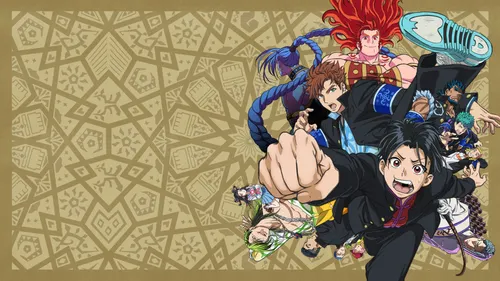
Bucchigiri?!: When Delinquent Grit Collides with Mythic Fantasy in a Masterpiece of Animated Chaos
In the Winter 2024 anime season, a series exploded onto the scene with a visual and narrative audacity that demanded attention. Bucchigiri?! (translatable as “Bloodshed?!” or “No-Holds-Barred?!”) is not just another delinquent anime. It is a genre-defying, palette-exploding spectacle that takes the classic template of high school turf wars and supercharges it with the epic, magical framework of One Thousand and One Nights.
Created by MAPPA and directed by the acclaimed Hiroko Utsumi (Sk8 the Infinity, Banana Fish), the series follows the timid Arajin Tomoshibi, who transfers to a new school only to be caught between two warring factions and a mysterious, shirtless genie named Aladdin who emerges from a magic lamp.
What unfolds is a delirious, heart-pounding, and deeply stylish fusion of street brawls and supernatural destiny, where fistfights are intercut with mythic visions and a teenager’s social anxiety is literalized as world-ending power. Bucchigiri?! is a love letter to classic delinquent manga, a bold experiment in color theory, and a story about finding your own strength in the most unexpected of places.
Information 

Bucchigiri?!
➻ Type :- TV
➻ Genres :- #Action, #Comedy, #Supernatural, #School
➻ Status :- Finished Airing (Season 1)
➻ Aired :- 2024
➻ Language :- Tamil
➻ Episode :- 12
➻ Duration :- 24 min per ep
This guide is your key to understanding its chaotic brilliance. We will unpack Arajin’s split persona, decode the Majin power system, explore the warring factions of Shinsengumi and Kyougoku, and analyze the series’ groundbreaking, hyper-kinetic animation style that makes every frame a work of art.
Table of Contents
Prologue: The Timid Transfer Student and the Lamp – A Premise of Duality
The story begins with a classic setup: Arajin Tomoshibi, a painfully shy and socially anxious teenager, transfers to a new high school hoping for a fresh start away from a troubled past. His hopes are immediately dashed upon discovering that his new school, Onmyou Academy, is ground zero for a brutal gang war between two dominant factions: the disciplined, honor-bound Shinsengumi and the chaotic, power-hungry Kyougoku.
While fleeing from immediate danger, Arajin stumbles into a bizarre, run-down shop and discovers a dusty, ornate lamp. Rubbing it in a moment of desperation, he doesn’t summon a wish-granting genie in the traditional sense. Instead, he unleashes Aladdin—a perpetually shirtless, supremely confident, and impossibly powerful being who looks exactly like Arajin’s idealized, cooler, more assertive self from middle school.
Aladdin explains the rules: Arajin is his “Master,” and they are bound by a “Covenant.” Aladdin will lend Arajin his immense power in times of extreme need, but there is a catch. This power draws from Arajin’s own latent potential and emotions, and its uncontrolled use risks awakening something far more dangerous within Arajin himself: a terrifying, destructive alter-ego.
Thus, the core dynamic is established. Arajin is not just a kid caught in a gang war; he is a vessel for a mythic power he cannot control, forced to navigate a violent social hierarchy while managing the literal ghost of his past self. The question isn’t just “can he survive?” but “can he integrate these warring parts of himself before one consumes the other?”
Chapter 1: The Protagonist – Arajin Tomoshibi, The Fractured Vessel
Arajin is a protagonist defined by contrast and internal conflict.
- The Anxious Core: At his heart, Arajin is kind, gentle, and deeply fearful of conflict. His past experiences have left him with a desire to be invisible, to avoid making waves. This makes his placement in the hyper-masculine, violent world of Onmyou Academy a perfect crucible for comedy and drama.
- Aladdin – The Ego Ideal: Aladdin is not a separate entity but a manifestation of Arajin’s repressed confidence, courage, and swagger from a time before he was beaten down by life. Aladdin is everything Arajin wishes he could be: fearless, charismatic, and physically dominant. Their interactions are a form of internal dialogue made external, with Aladdin pushing Arajin to stand up for himself.
- The Third Self – The “Majin” Within: Lurking beneath both the timid Arajin and the boastful Aladdin is a more primal, destructive force. This is the true “Majin” power, a raw, chaotic energy tied to Arajin’s deepest insecurities and rage. The series’ central tension is Arajin’s struggle to harness Aladdin’s strength without letting this monstrous third self take over, making his journey one of psychological integration as much as physical combat.
Chapter 2: The Warring Factions – Shinsengumi vs. Kyougoku
The delinquent landscape of Onmyou Academy is a carefully crafted ecosystem with distinct philosophies.
The Shinsengumi: Code and Camaraderie
Named after the legendary Japanese policing force, this faction values discipline, loyalty, and a strict code of honor.
- Leadership: Led by the calm, strategic, and immensely strong Matakara Asamine. He is less a tyrant and more a revered captain, seeking to maintain order and protect his territory through strength and principle.
- Philosophy: They fight for respect and territory, but with rules. They represent a romanticized, “noble” side of delinquency where strength serves a communal purpose.
- Key Members: Include the hot-headed but loyal Kenichiro, and eventually, Arajin finds an uneasy place among them, drawn to their sense of belonging.
The Kyougoku: Chaos and Conquest
A faction defined by its hunger for raw power and dominance, with a hierarchical structure based purely on strength.
- Leadership: The enigmatic and terrifying Mahoro. He is a force of nature, seeking not just to rule the school but to crush all opposition to prove his absolute supremacy. He represents the chaotic, ego-driven side of power.
- Philosophy: Survival of the fittest. They seek to absorb or destroy the Shinsengumi, viewing their code as weakness. Their ambition makes them the primary antagonistic force driving the conflict.
- The “Zoshoku”: High-ranking members within Kyougoku who possess their own awakened or latent Majin-like powers, hinting at a deeper, supernatural layer to the gang war.
Chapter 3: The Power System – Majin, Covenants, and Mythic Resonance
The supernatural layer of Bucchigiri?! is deeply intertwined with its Arabian Nights theme.
- Majin (Demon Gods): These are the ancient, mythic powers awakening within certain individuals. Aladdin is a unique Majin bound to a lamp. Others, like Mahoro and eventually key members of both factions, manifest powers that reference other figures from Middle Eastern folklore (Ifrits, Marids, etc.). These powers are tied to the user’s personality and emotions.
- The Covenant: The bond between Arajin and Aladdin. It’s a contract that allows for the sharing of power but comes with strict, mystical rules and a heavy price if broken. The nature of this covenant and its true purpose is a central mystery.
- Visualizing the Power: When Majin powers activate, the animation style shifts dramatically. The world might warp into a tapestry of Islamic geometric patterns, colors become hyper-saturated, and the fights take on a weightless, surreal quality. The power isn’t just strength; it’s a reality-altering force.
Chapter 4: Artistic Direction & Animation – A Visual Revolution
This is where Bucchigiri?! truly separates itself from the pack. The production is a masterclass in stylized animation.
- The “Utsumi Style” on Overdrive: Director Hiroko Utsumi’s signature dynamicism is fully realized. The camera angles are extreme, the character movements are exaggerated and fluid, and the action sequences are choreographed with a balletic, yet brutal, grace.
- Color as Emotion: The color palette is a character itself. Scenes shift from the muted, realistic tones of Arajin’s anxiety to the blinding, psychedelic neon explosions of a Majin battle. Specific characters are associated with specific colors (Mahoro often with oppressive reds and purples, Aladdin with warm golds and blues), creating a visual language.
- Text and Onomatopoeia: The series heavily incorporates dynamic text and sound effects into the frame, much like the pages of a manga come to life. Punches are accompanied by crashing “BUCCHI!” or “GIRI!” text, and impact frames are filled with stylized kanji and patterns.
- Cultural Fusion in Design: The character designs blend modern Japanese delinquent fashion (long coats, gakuran, pompadours) with ornate, Middle Eastern-inspired accessories and motifs. The backgrounds seamlessly mix a gritty, lived-in Japanese urban landscape with sudden, majestic visions of desert palaces and starry nights.
Chapter 5: Themes – Beyond the Brawl
Beneath the flashy fights and loud comedy, Bucchigiri?! explores resonant themes of identity and belonging.
- The Construction of Self: Arajin’s journey is about integrating his fractured selves—the timid present, the confident past (Aladdin), and the monstrous potential—into a coherent, healthy whole. It’s a metaphor for overcoming trauma and social anxiety to forge a genuine identity.
- The Search for a “Place to Belong”: The delinquent gang framework is ultimately about this. The Shinsengumi offers a place with rules and brothers. Kyougoku offers a place for the powerful. Arajin must find where he fits, if anywhere, on his own terms.
- The Burden and Allure of Power: The Majin powers are a double-edged sword. They offer the strength to protect and dominate, but they also corrupt, isolate, and risk destroying the user from within. The series questions what one is willing to sacrifice for power.
- Fate vs. Free Will: The Arabian Nights framework suggests a pre-written destiny (the Covenant, the awakening Majin). Arajin’s struggle is to assert his own will against these seemingly predestined roles.
Chapter 6: The Supporting Cast – A Gallery of Wild Cards
The world is populated with memorable characters who each represent different aspects of the central conflict.
- Marito: Arajin’s first friend at the new school, a non-combatant who provides humor and a grounded perspective on the insane world of gang wars and genies.
- The Shopkeeper: The mysterious proprietor of the lamp shop, who seems to know far more about the Covenant and the awakening Majin than he lets on, serving as a cryptic guide.
- Other Majin-Bearers: As the story progresses, other students reveal their connections to mythic powers, expanding the conflict from a simple turf war into a hidden supernatural war playing out in the halls of a high school.
Chapter 7: Cultural Context & The Delinquent Genre Revival
Bucchigiri?! doesn’t exist in a vacuum; it is a conscious, modern evolution of a classic genre.
- Homage to Classics: It wears its influences on its sleeve, evoking the spirit of legendary delinquent manga like Be-Bop High School, Crows, and Worst, while injecting a completely novel fantasy element.
- A New Take for a New Generation: It takes the testosterone-fueled, often hyper-masculine world of classic delinquent stories and filters it through a contemporary lens that includes psychological depth, fluid identity, and a kaleidoscopic visual style that appeals to a digital-native audience.
- MAPPA’s Creative Gambit: Following the intense, dark productions of Chainsaw Man and Jujutsu Kaisen, Bucchigiri?! showcases MAPPA’s range, proving they can deliver a show that is just as creatively bold but tonally vibrant and playful.
Conclusion: A Spectacle That Demands to Be Seen
Bucchigiri?! is not a subtle anime. It is a loud, proud, and brilliantly executed explosion of style, substance, and sheer creative joy. It takes two seemingly incompatible genres—the grounded delinquent drama and the high-flying Arabian fantasy—and smashes them together to create something wholly original and electrifying.
At its core, beyond the spectacle, it is a relatable story about a kid trying to find his courage and his people in a world that feels designed to crush him. It’s about the battles we fight in the schoolyard and the much larger battles we fight within ourselves. With its unparalleled animation, compelling character dynamics, and fearless commitment to its own chaotic vibe, Bucchigiri?! isn’t just a good anime; it’s a statement.
A statement that anime can still surprise, innovate, and deliver pure, unadulterated fun with a surprising amount of heart. If you’re ready for a fight where every punch is a painting and every enemy could be a demigod, then step into the ring. The brawl of the century has begun, and its name is Bucchigiri?!

Also Check
- Akebi’s Sailor Uniform (Season 01) Tamil [480p 720p 1080p]
- Good Bye, Dragon Life (Season 01) Tamil [480p 720p 1080p]
Final Summary 🪶
IMDB - 6.2
MyAnimeList - 6.6
6.4
Average
Bucchigiri is wild and full of attitude. It mixes street fights with supernatural elements in a really stylish way. The energy is loud, chaotic, and fun to watch. If you like flashy action with a unique vibe, you’ll enjoy it.


2 Comments