
A Misanthrope Teaches a Class for Demi-Humans (Season 01) Tamil – Multi Audio [480p 720p 1080p]

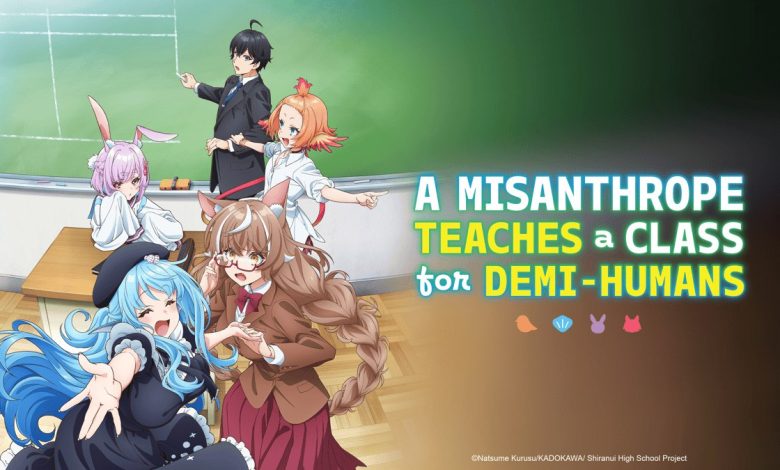
A Misanthrope Teaches a Class for Demi-Humans: Can a Man Who Hates Humanity Teach It?
The Winter 2026 anime season has brought us a title that immediately grabs attention: A Misanthrope Teaches a Class for Demi-Humans (Jingai Kyōshitsu no Ningen-girai Kyōshi). Adapted from the light novel series by VTuber-author Natsume Kurusu, this show presents a premise ripe with comedic and dramatic potential.
A burned-out teacher who despises humanity finds himself employed at a peculiar school where non-human students—mermaids, werewolves, rabbit-eared girls, and more—are striving to become fully human. What could go wrong? Or, perhaps more importantly, what could go surprisingly right?
Information 

A Misanthrope Teaches a Class for Demi-Humans
➻ Type :- TV
➻ Genres :- #Drama, #Comedy, #Slice of life
➻ Status :- Ongoing (Season 1)
➻ Aired :- 2026
➻ Language :- Tamil , Hindi , Telugu , Japanese
➻ Episode :- 12
➻ Duration :- 24 min per ep
This guide explores the world of A Misanthrope Teaches a Class for Demi-Humans, examining its source material, characters, production team, and the sharply divided reception that has made it one of the most talked-about (and debated) shows of the season.
Table of Contents
Prologue: A Teacher’s Second Chance
The premise of A Misanthrope Teaches a Class for Demi-Humans is deceptively straightforward. Rei Hitoma is a licensed high school teacher in his late twenties, but a traumatic experience in his previous teaching job has left him a NEET—living with his mother, playing video games, and nursing a profound hatred for humanity. Prodded by guilt, he reluctantly applies for a teaching position at a remote mountain school, expecting a quiet, undemanding post where he can coast through life.
What he finds instead is Shiranui High School, an institution unlike any other. This is a school for demi-humans—animals, spirits, and mythical creatures—who wish to become full-fledged human beings. And Rei, this self-proclaimed misanthrope, has been placed in charge of the advanced class: four girls on the cusp of graduation who need to learn what it truly means to be human .
As the official synopsis from Yen Press puts it: “It’s my duty to teach them about humankind—and maybe in the process, I’ll learn a few things myself. This isn’t an alternate world or a case of reincarnation. It’s just the story of a teacher at a somewhat peculiar school and his students who are striving to become human” .
Chapter 1: The Source Material – From VTuber to Light Novel Sensation
The origins of A Misanthrope Teaches a Class for Demi-Humans are as unconventional as its premise. Author Natsume Kurusu is not just a novelist—she is also a VTuber affiliated with the popular agency NIJISANJI. Her journey to publication began when a follower, who later became her editor, encouraged her to expand her short stories into a light novel series .
What makes the series particularly unique is its development process. Kurusu actively involved her online community, using prompts and suggestions from fans on YouTube and X (formerly Twitter) to construct individual chapters. This collaborative approach imbues the work with a sense of community that resonates throughout the narrative .
The light novels, illustrated by Sai Izumi, began publication under Media Factory’s MF Bunko J imprint in February 2022. Four volumes have been released as of February 2025, with Yen Press handling the English-language edition . A manga adaptation illustrated by Atsu Benino ran in Monthly Shōnen Ace from August 2022 to July 2025, collecting four volumes .
Chapter 2: The Characters – A Classroom of Contradictions
Rei Hitoma: The Reluctant Educator
Voiced by Toshiki Masuda, Rei Hitoma is the anchor of the series. He is a man defined by contradiction—a teacher who hates teaching, an educator who distrusts humanity, a professional who failed at his profession. His past trauma, hinted at but not fully revealed in early episodes, has left him emotionally scarred and professionally paralyzed .
Yet there is something in Rei that refuses to quit. He applies for the job. He accepts it. And despite his constant internal protests, he proves to be genuinely good at it. As the novels progress, we see a teacher who, while awkward and perpetually uncomfortable, offers sincere kindness to his students and admits his weaknesses to them in meaningful ways .
The Advanced Class: Four Paths to Humanity
Rei’s homeroom class consists of four demi-human girls, each with her own reason for wanting to become human :
- Kyouka Minazuki (Mermaid) – Voiced by Sora Amamiya. A mermaid with a passion for dance—a difficult pursuit for someone with a fish tail. Her story incorporates elements of Hans Christian Andersen’s original “Little Mermaid” fairy tale, adding layers of literary resonance to her arc .
- Isaki Oogami (Reverse Werewolf) – Voiced by Saori Ōnishi. A werewolf who turns human once a month, Isaki has always felt caught between two worlds. Her human and wolf selves have opposing personalities—one shy, one outgoing—and her journey involves learning to accept both halves as part of a unified whole .
- Sui Usami (Rabbit) – Voiced by Maria Naganawa. The prickliest member of the class, Sui’s sharp exterior masks deep emotional wounds. Her chapter in the novels is widely considered the standout, achieving a depth of emotion that critics have praised as genuinely moving .
- Tobari Haneda (Bullheaded Shrike) – Voiced by Rui Tanabe. A bird demi-human whose boundless energy and enthusiasm sometimes overwhelm her more reserved classmates. Her backstory, revealed gradually, adds unexpected depth to her character .
The Supporting Cast
Later volumes introduce additional characters, including Neneko Kurosawa (a black cat girl who doesn’t actually want to become human) and Machi Nezu (a mouse girl with an obsession with food and her younger sister). These additions expand the thematic scope of the series, exploring different motivations and relationships .
Chapter 3: The Anime Adaptation – Production and Premiere
The anime adaptation of A Misanthrope Teaches a Class for Demi-Humans was announced on September 7, 2025, generating significant buzz among fans of the light novels .
Production Team
The series is produced by studio Asread, known for works including Future Diary and Shuffle!. The creative team brings impressive credentials:
- Director: Akira Iwanaga, whose previous work includes Arifureta: From Commonplace to World’s Strongest
- Series Composition: Katsuhiko Takayama, known for I’m the Evil Lord of an Intergalactic Empire!
- Character Design: Maiko Okada
- Music: Makoto Miyazaki, whose credits include the acclaimed score for One Punch Man
Premiere and Streaming
The series premiered in January 2026, with Crunchyroll streaming the episodes as they air in Japan. A new main visual was released on the day of the premiere, featuring the tagline: “Sensei, can you teach us about humans…?” .
The ending theme song, “Ningen COME TRUE,” is performed by the four main actresses—Sora Amamiya, Saori Ōnishi, Maria Naganawa, and Rui Tanabe—in character, adding an extra layer of immersion for viewers .
Chapter 4: Themes – What Does It Mean to Be Human?
Beneath its seemingly lighthearted premise, A Misanthrope Teaches a Class for Demi-Humans engages with surprisingly complex thematic material.
Assimilation and Identity
At its core, the series asks a difficult question: What does it mean for these demi-humans to “become human”? Are they literally transforming, their animal ears and tails disappearing as they discard their original nature? Or are they simply learning to pass, to wear a magical glamour that allows them to navigate human society ?
This ambiguity carries uncomfortable echoes of real-world discussions about assimilation, cultural identity, and the pressure to conform to dominant norms. As one critic noted, “the vibes of a school where the students are punished for not assimilating well enough are weird” .
Healing Through Teaching
The parallel journey of Rei and his students is the series’ emotional backbone. As the demi-humans learn about humanity, Rei slowly rediscovers his own faith in people. His students, in their earnest desire to become human, remind him of the qualities worth valuing—kindness, perseverance, connection.
The novels excel at showing this mutual growth. As one reviewer noted, “Rei offers sincere kindness to see his pupils grow. At the same time, the slightly awkward teacher will admit his weaknesses and open up to his students meaningfully” .
The Burden of the Past
Rei’s trauma, though not fully detailed in early episodes, hangs over every interaction. His reluctance to engage, his defensive cynicism, his fear of being hurt again—these are the scars of whatever happened in his previous teaching job. The series suggests that healing requires confronting the past, a lesson that applies equally to teacher and students .
Chapter 5: Critical Reception – A House Divided
If there’s one thing consistent about the reception of A Misanthrope Teaches a Class for Demi-Humans, it’s inconsistency. Critics have sharply diverged in their assessments, creating a fascinating case study in how different viewers can see entirely different shows in the same material.
The Positive Perspective
Supporters of the series point to its emotional depth and genuine moments of poignancy. Rebecca Silverman of Anime News Network, reviewing the light novels, gave the series a B+ grade, praising its focus on “actual student/teacher relationships and mutual learning” and singling out Sui Usami’s chapter as a standout .
The novels have been praised for subverting expectations. Despite the premise’s potential for problematic teacher-student dynamics, Rei consistently rebuffs any romantic advances from his students, maintaining professional boundaries and focusing on their growth rather than their affection .
The Critical Perspective
The anime adaptation has faced harsher scrutiny. The Anime Feminist review delivered a blistering critique, calling the show “astonishingly bland” and taking issue with what they saw as poor direction, repetitive animation, and uncomfortable undertones .
The review from Anime News Network’s Winter 2026 Preview Guide was similarly divided. Caitlin Moore compared the show unfavorably to Interviews with Monster Girls, criticizing the “cowardly character design” and the lack of distinctive features beyond ears and tails. Richard Eisenbeis raised concerns about the assimilation narrative, while James Beckett questioned the fundamental premise of teacher-student romantic fantasy .
Rebecca Silverman, despite her positive view of the novels, found the anime adaptation disappointing, citing grating vocal performances and murky internal logic .
The Audience Verdict
The community score on Anime News Network currently sits at 3.9 out of 5, suggesting that general viewers are more forgiving than professional critics . This divide reflects a common pattern in anime fandom: material that works beautifully in print can struggle in adaptation, and elements that bother some viewers barely register for others.
Chapter 6: The Controversies – Navigating Sensitive Terrain
No discussion of A Misanthrope Teaches a Class for Demi-Humans would be complete without addressing the controversies that have surrounded it.
The Teacher-Student Dynamic
The premise—a young male teacher in close contact with teenage demi-human girls—inevitably raises questions about romantic and sexual undertones. The light novels address this directly, with Rei explicitly stating his disinterest in students and maintaining clear boundaries. However, as some reviewers noted, the books also include moments that feel unnecessary, such as a breast-groping scene in volume two that serves no plot purpose .
The anime adaptation has faced similar scrutiny. James Beckett’s review acknowledged the inherent weirdness: “Rei is the self-insert guy whose kindness and understanding will endear him to the affections of all the different demi-human girls in his class, and even if nothing explicitly sexual goes down, the show is still playing around with that nebulous mix of paternal/fraternal/mentor attraction” .
The Assimilation Narrative
The premise of non-humans learning to “become human” has drawn criticism for its parallels to assimilationist ideologies. As Richard Eisenbeis noted, “Rather than learning to accept yourself for who you are, this is a story about throwing away your culture and history to join another” .
The series complicates this reading by giving each student a deeply personal reason for pursuing humanity—a mermaid who wants to dance, a werewolf seeking wholeness—but the underlying framework remains potentially problematic.
The “Monster Girl” Label
Several critics have questioned whether the series deserves its “monster girl” categorization. The demi-humans, they argue, are essentially normal moe girls with animal ears and tails, lacking the distinctive characteristics that would make them genuinely non-human. As one review put it, “This is just Diet Monsterfucker Trash for cowards” .
Conclusion: A Series Worth Watching?
A Misanthrope Teaches a Class for Demi-Humans arrives with baggage—a provocative title, a controversial premise, and a source material that divides readers. Yet within that baggage lies a story that, at its best, offers genuine emotional resonance and thoughtful exploration of what it means to be human.
The anime adaptation faces the challenge of translating a novel praised for its internal depth into a visual medium constrained by time and budget. Early returns suggest a mixed success at best, with production values that fail to elevate the material and directorial choices that sometimes undermine it.
For viewers who enjoy slice-of-life narratives with fantasy elements, who can look past occasional awkwardness to find the heart beneath, A Misanthrope Teaches a Class for Demi-Humans may prove rewarding. For those sensitive to problematic dynamics or seeking high production values, other options this season may serve better.
What remains undeniable is the series’ ambition. In asking what it means to become human—and whether a man who hates humanity can teach that lesson—it tackles questions that resonate far beyond its fantasy premise. Whether it succeeds in answering them is, ultimately, for each viewer to decide.

Also Check
- Trigun Stargaze (Season 01) Tamil – Multi Audio [480p 720p 1080p]
- Yuri!!! on ICE (Season 01) Tamil – Multi Audio [480p 720p 1080p]
Final Summary 🪶
IMDB - 6.4
MyAnimeList - 6.9
6.7
Average Score
A Misanthrope Teaches a Class for Demi-Humans has that calm fantasy classroom vibe. The grumpy teacher slowly bonding with demi-human students gives it a wholesome core. It’s more about character growth and small emotional moments than big action. If you like slow, heartwarming fantasy stories, this one’s a nice pick.

One Comment